Showing posts with label Umbango. Show all posts

Sunday, 15 August 2021

Borambola Station Building - 1


Borambola Station

Borambola was located 41km from Wagga - almost halfway between Wagga, and Humula.  It opened in 1917.

Facilities as built included an A4 station building, a toilet block, a J1 station master residence, a G2 goods shed, stock loading ramps, and an elevated water tank with pump from a nearby creek.


Uranquinty Station was relocated from Borambola in 1935.  Why such a substantial station building was built at Borambola remains a mystery to me.  I took this picture in 1990, prior to Uranquinty's station demolition

Rear of Uranquinty station


I have no idea what the thinking was.   Whilst Borambola once had a primary school, I can find no evidence that there was ever enough population to justify an A4 station building.  It took just 18 months for the Station Master position to be removed.  And it would come as no surprise, that in 1935, the station was relocated to Uranquinty.  A small corrugated iron shed was substituted.

Pictures of Borambola station


Mark Pottie visited Borambola in 1982, and photographed the station building/shed. This image is scanned from the Tumba Rail booklet 'Wagga Wagga to Tumbarumba Railway - "An era of change"' and used with permission. Is the round water tank visible on the LHS, originally from the station?

Looking south, my only visit to Borambola was in the early 1980s.

Closeup of my slide image
Looking North - the silhouette of the station building has no details useful for a model of the station.  

I only visited the station site once in the early 1980s, but failed to take enough photos.  At that stage, I was not planning to model the line.  My memory of the building was it was a simple drafty corrugated iron shed, with nothing to indicate the station once had more importance.

Researching Borambola has been difficult.   Most of the photos I have in my accumulations are of the G2 goods shed, followed by the elevated water tank, and the stockyards.  I have no images of the A4 station or J1 station master residence prior to their removal.  Seems to me the replacement station building (or waiting shed), lacked any appeal to photographers.  Had the station been built small to start with, it might have looked like Umbango – a lot nicer.

Unbango - photographed by Graeme Skeet in the mid 1980s.  This station was constructed by 1917 for the opening of the line.  It similarly sized to Borambola's station shed, and also shares the trait of the nameboard above the door 
Graham Pegg photographed a tour train in front of the elevated water tank in 1965.  The goods shed roof is just visible on the RHS of the image. The station building is hidden by 3020, the second loco of the train.

Graeme Skeet also photographed Borambola, this image taken from the nearby Mate's Gully Road.  Assume the station area was no longer accessable.  At first glance, it shows the good shed, however, the station building (with part of the tin roof missing) is just discernable.  This is the only picture I have showing the station front doorway, more or less front on. The other thing to note is the closeness of the communication/telegraph pole. I don't recall any safeworking wiring within the shed, but it probably existed at some stage


The model

Without measurements, I based my model’s dimensions on a NSW A1 station, although it might have been slightly bigger.   

The A1 station building plan of 1909 - a portion of Data Sheet B2 by Greg Edwards.  These sheets are invaluable for anyone wanting to scratchbuild or detail NSW structures


From memory, the tin shed at Borambola did not have the rear window, and I don't recall any interior wooden cladding or even a seat.  So my interior is  fantasy.  In my defence, I would rather construct something that is moderately attractive, for a working railway line, rather than an abandoned and stripped structure.

Construction was fairly simple.  Cut out the sides, and floor – scribe the walls, and cement into position.  The internal framing done with evergreen styrene strips.  Seating based on the Greg Edwards data sheet – although my rendition of this is rather crude, it should work in the gloom once the roof is on.

After cutting out the sides, and floor, I made a start on assembly before I scribed the interior boards. Whoops.  This made the scribing a bit trickier.

On the underside, I cemented in some joists for the piers that would support the rear of the structure

Interior framing was easy with evergreen styrene strips (0.030 x 0.040). There will be no lighting inside the structure, so there was no need to beef up the walls to prevent stray light showing through.

Rather than 2 sets of seats as per Gregs diagram (which would be virtually invisible when the structure is positioned on the layout, I made use of the lack of a window, and ran the seating along the rear.  The effectiveness of the scribing hides the flatness of the rear of the Evergreen corrugated iron sheets quite effectively


Next stage is to finish the doorway, construct the roof, and paint.  And I might have to fit a water tank to the side - similar to Umbango.  It wasn't in place in the early 1980s, but probably was in 1970.

Stay safe during the lockdown – build a model or two.


Sunday, 25 July 2021

Timber station platforms


Timber station platforms.

  Some prototype pictures, and a modelling experiment


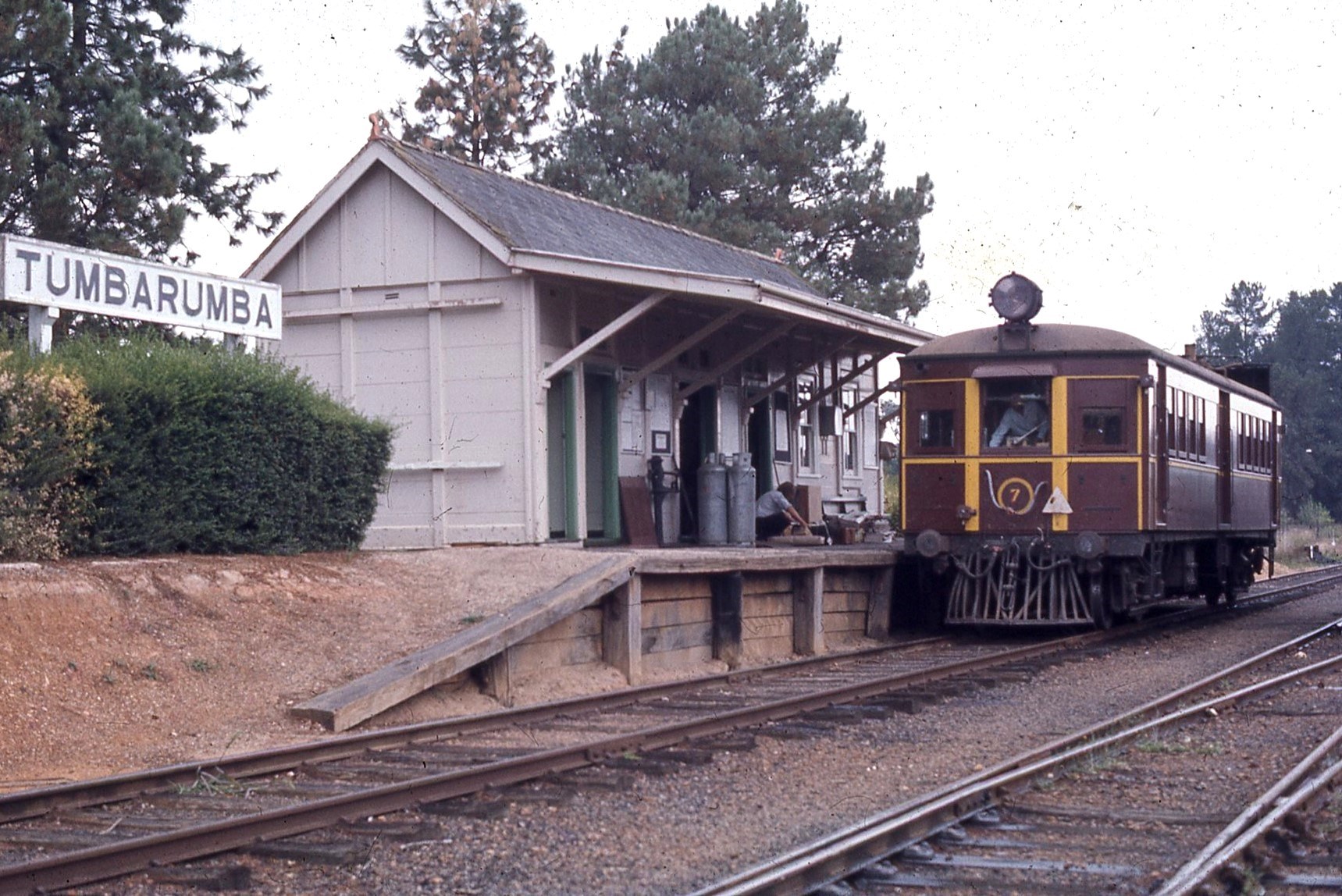
Brian Wooley captured CPH7 at Tumbarumba in 1973. Whilst the platform is the focus of this blogpost, the details on the platform add much interest

Anyone modelling a NSW rural branchline, will probably need a timber platform.

For something so common, I have found very little in the modelling press.  James McInnerney did a fine review, almost a mini article of the Rail Central brand (supplied by Casula Hobbies) way back in Issue 276 AMRM (June 2009). The other resource, the Greg Edwards Data sheet B11 is quite informative.  But I do not know of any prototype article, like when they were first used.

In any case, the branchline to Tumbarumba had many of them

 Pictures of platforms

In 1980, my picture of the abandoned station, shows the length of the platform
CPH #7, at Humula in 1973. The platform is significantly longer than Tumbarumba

My 1980s picture of Borambola shows the loading bank timber platform. It is slightly higher than a station platform, but the basic design is similar.  The  G2 goods shed, and the A1 station building are in the distance.

Coreinbob station platform in 2020 has almost disappeared. Coreinbob is one of the intermediate stations that I unfortunately will not have space to model
Forest Hill platform, after the station building was removed.


Rod Smith, and his son accompanied me in August 2020 to visit a number of the remaining relics of the Tumbarumba line. Here are the remains of Umbango, which is north of Humula. Note the use of rail as the bracing support for the platform post. Another station I will be unable to model, although Umbango's station was similarly sized to Borambola

Ladysmith station after being leased by the Tumba Rail volunteers. The platform used to extend a far distance to the left hand side of this picture, truncated in the 1970s by the NSW railways, possibly to eliminate the need to repair.

This is what happens when the platform is removed, after the line was abandoned in 1984. It is Gundagai, on the Tumut branch in 1997.

Fortunately, grant money was found, and a replacement platform was built by 2000. Both these images are mine


The experiment

I was recently given an RTV rubber mould of a NSW platform.   After some advice, I thought I would try my hand at casting a platform out of plaster.

The RTV mould.
I used a disposable plastic cup to mix up the minute amount of plaster into a slurry

My casting plaster was bought when phone numbers were 7 digits long. the heavy plastic kept the contents fresh.

I pre-wet the mould with dishwasher soup, and then poored and prodded the plaster into the cavities of the mould


Before the plaster went off, I removed the excess

After allowing the casting to dry for a day, time to extract from the mould. Unfortunately, the top rail of the castings was weak, and I lost many of them. Not helped by the few air bubbles. Plus there were a number of the castings split.

White Glue will fix the broken castings (to a point).

Another batch was made - with slightly better results. 

 Of course, if you need to model a platform that is starting to decay (see Borambola above) it is OK.  There is certainly enough good bits across both castings to make a full platform, but that was not the intention.


I thought I would try to replace/repair the missing top rail, using a strip of styrene. 

To get a better comparision, constructed some platform faces with other methods

Nothing models timber better than timber?  I should have used a square when gluing the uprights, but it probably will pass muster once installed in scenery


Another platform, fully out of styrene. Yes, there is a gap. What isn't visible, but the top rail and the platform timbers have a rebate to facilitate the platform surface to be supported when added later 


The conclusion

Well, whilst the casting process is repeatable, my lack of being able to extract the casting out of the mould without damaging the casting, is frustrating.  Yes, I can add the top timber board from styrene after cleaning up the cast, and a styrene edge will take the odd knock better than straight plaster.  The plaster is also rather brittle.  Maybe a change to a resin may be superior to the plaster?

The timber model was far too fiddly to repeat.

Making the platform out of styrene has the advantage of working with just a single material.  This may be better in the long term.

And all models will need to be painted (or stained).

A bonus extra


A large scale model?  Two of Petes Hobby Railway volunteers, Phil, and Josh, constructed a platform for Pete's 2 foot gauge line, running in Junee, about 1km from where I live. It is scaled approximately 50%, to look like a NSW platform 

Pete's Hunslet loco "Torpedo" passes the under construction reduced size NSW A1 station. This is the view you will see from the public viewing area (roadside). The stationname of Loftus has a double meaning. It is where Pete lived before moving to Junee, and the original railway construction name of Junee was "Loftus".  Pete has a website. Search for "Petes Hobby Railway" with your favourite search engine 


This has been another fill-in project whilst I wait for the etches for the Wagga Wagga station.  The advantage is that I can store them flat.

Until next time.