Beyond
Docker Street
When I was
designing my layout based on Wagga Wagga, I was interested in including as many
industries as possible. The track
between Docker, and Urana street contained the following possibilities
- Showground
- Willis Bricks
- Hardy’s Timber
- Gasworks
- LPG depot
-Trucking yards.
 |
In 1954, the Wagga Daily Advertiser published a photo showing the Trucking Yards, and the showground platform, and entry gates. Whilst the showground is not being modelled, the trucking yards (sheep on the left of the picture, cattle on the right) were essentially unchanged until removal after 1979
|
 |
| A not to scale sketch showing the trackplan and associated sidings |
 |
| 1971 Aerial view shows the actual sidings. Quite a number of wagons can be seen - mostly bogie stock wagons, and a number of BCHs on the gasworks siding |
 |
| By 1990, the trucking yards were gone, and the only evidence of the siding to the gasworks is the curved fence on Hardys timber. Willis Bricks pit looks about the same size, so I don't know if it was still operational. Hardys timber has more buildings, and the LPG depot also has a few more structures |
The
showground
A recent
article appeared in the November 2019 Australia Railway History magazine,
describing the showground siding, and operation. This siding was well out of use by 1970, and lacking
any photographic remains by 1970, I will not be including it
Willis
Bricks
A siding
was laid for Willis Bricks in the 1930s according to my research. Willis Bricks was a major brickworks for
Wagga, including its own small tramway system.
The 1954 Daily Advertiser photo does not show a siding, so perhaps the
earlier information was in error. In any
case, I have not been able to discover if or when they used the railways
to transport their bricks, and whilst
modellers licence could be used, I do not plan to include it
 |
| The 1954 Daily Advertiser image of the brick pit shows the tramway incline |
Hardys
Timber
A siding was
used by Hardys Timber until sometime after 1970s. There were 2 major sawmills on the Tumbarumba
branch:- at Humula, and Tumbarumba that sent cut timber by rail – and I expect
that one of the destinations was Hardys. Having both the sawmills, and the
receiving/retail outlet included on the one layout is a significant bonus for
operation
 |
| Hardys timber in 1954 shows neatly stacked lumber. Note The line of 4 wheel stockcars in the sidings |
Gas
Works
A new
gasworks was established in 1964, and a point was laid off the Hardys timber
siding for an extended siding. As is common
with coal gasworks, there was incoming coal wagons, and one of the byproducts of
coal gas production is coke. The
gasworks was being decommissioned when I photographed it in the 1990s, but I
did note 3 chutes above the then removed siding – which I assume was for the
coke. The gasworks siding was drawn in
1962s plans with a loop for a loco to run around the coal wagons. I am not sure if this was done, as my 1970
aerial picture is not clear
 |
| Closeup of the 1971 aerial view -shows the line of BCH awaiting to be unloaded. The LPG depot is in the bottom of this image |
 |
| One of the gasworks structures, with the enlarged LPG depot in the RHS foreground |
 |
| Out of use, the main retort building |
 |
| The third major structure, with the gasometer in the background |
 |
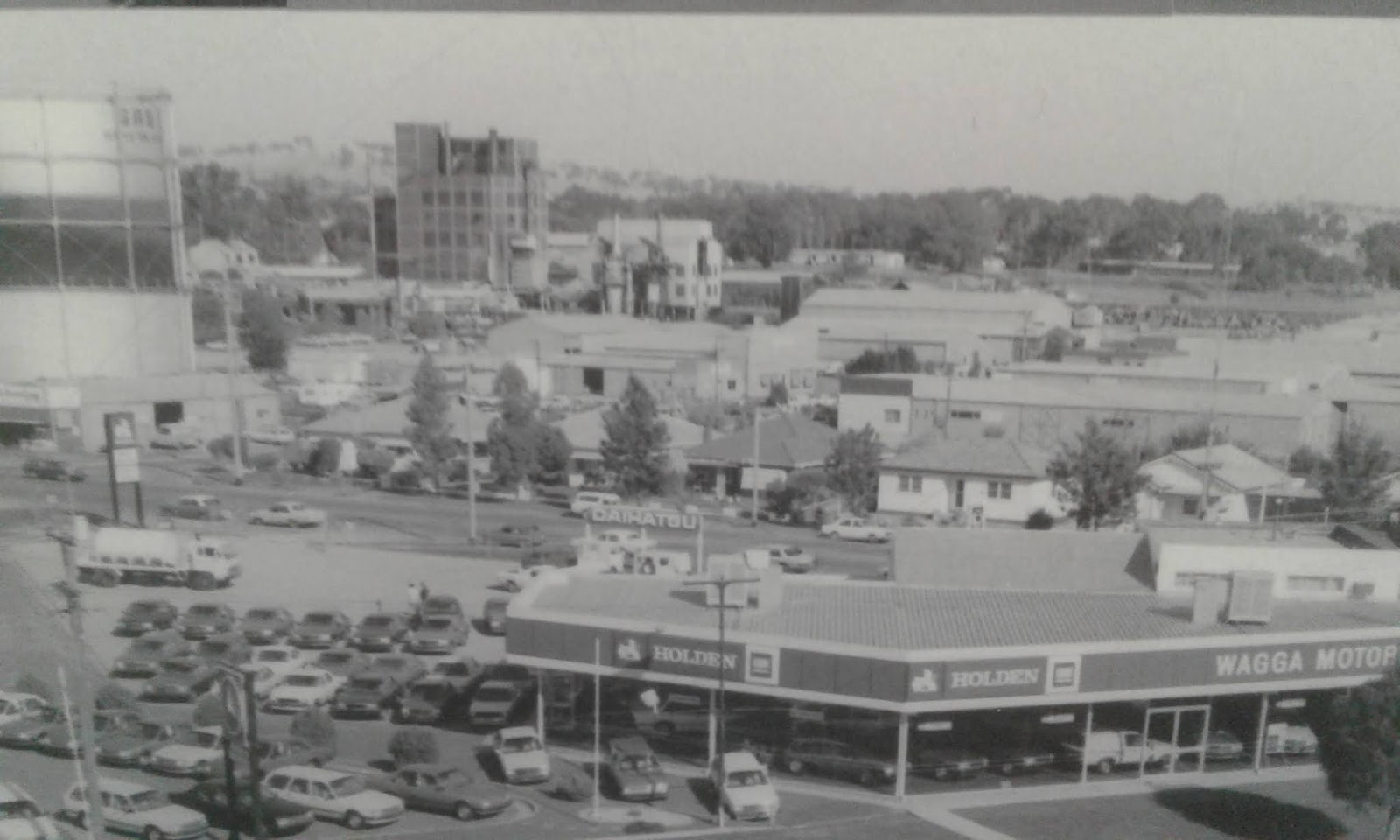
| The only picture I have showing the northernside of the gasworks. This is the side that people viewing my layout will see. This image is proudly displayed in Wagga Motors office waiting room. It is often unusual sources that give unusual angles |
LPG
Depot
Opposite
the gasworks, a large LPG depot was established. This was prior to 1970. The LPG depot seems to have its own siding –
assuming that the former gasworks loop was not in use. Most of this is speculative, as whilst I have
photos of the depot, the 1970s aerial picture only hints at unloading pipework.
But, I am fairly sure it did exist, as in a recent talk at the Epping club,
David Lowe reported on the movement of Speed E Gas tankers thru Goulburn, as
far as Wagga.
 |
| Here is the original shed as seen in the 1971 aerial image. The other sheds in the RHS background are later additions |
Trucking
yards
Wagga Wagga
was, and still is, a major selling centre
for sheep, and cattle. Line side trucking
yards were established, and fairly large trains could be handled, and stored on
the adjacent sidings. The saleyard complex in Wagga at the time was
on Travers Street, so stock was moved to/from these yards by road.
The
movement of sheep and cattle wagons will be a major focus of my model train operation. I plan to model these trucking yards, as well
as stockyards at the Bomen abattoir, and stock loading on the Tumbarumba branch
at Borambola, Humula, and Tumbarumba.
New
stockyards were built in Bomen by 1979,
and the Wagga stockyards, and trucking yards were removed.
 |
| The Pig trucking yard was closest to Urana Street |
 |
| The 1971 aerial view is virtually unchanged from the 1954 Daily Advertiser photo. The double stock race for sheep is to allow for loading on the 2 decks of the sheep vans |
Operation
Whilst it
is possible that stock trains could have entered the trucking sidings directly off
the mainline, my only picture of a stocktrain in Wagga shows the X203 shunting
engine with a number of CW wagons heading towards Docker Street. I also have pictures of coal wagons in the
Wagga sidings. So, I am going to make
assumptions – all trains with wagons for the Docker Street sidings are
disassembled in the main Wagga yard, and are moved from there to the Docker
street sidings by the X200 shunting engine, avoiding any timetabled mainline
trains
Modelling
notes.
Wagons. All the industries I hope to include, have
specific wagons.
-
SDS
Models have produced the Speed-E-Gas wagon, and I have acquired a small number
for the LPG depot.
-
Coal
Wagons for the gas works are fairly common. I made quite a number of AR Kits coal wagons in the 1980s/90s, and
recently acquired some Hi_Rail BCH wagons.
 |
| Phil Sloan photo from the 1970s shows a number of coal hoppers, and BSVs parked on the Wagga station sidings |
-
Stock
trains will be a feature. I own a small fleet of Eureka, SDS, and Columba bogie BCW cattle wagons, and
a few Eureka BSV bogie sheep vans. Plus
a pack of Austrains 4 CW cattle wagons. In addition, I have also made a number
of Casula, and Minimodel kits
 |
My photo - BSV in Wagga around 1980.
|
-
 |
| Keith Waine picture around 1967, shows X203 with a long rake of CW vans heading west towards the trucking yard sidings |
Timber
loads can be placed in S trucks, although I admit, I will have to do more
research to find other wagon types used for sawn timber loads. Photos would be helpful
Baseboards. The space I have allocated between the two
level crossings is around 6 metres long x 600mm wide. I am hoping that I will be able to include the
4 industries above, although to limit the space, I will be leaving out the Pig
stock races, moving the sheep, and cattle races closer to Urana Street, modifing
the trackplan, and relocate the LPG depot and gasworks structure so it appears a
lot sooner after Hardy’s timber.
=================================
Addendum.
Some more pictures since I posted in 2020.
 |
| Some pictures of Hardys Mill and siding from CSU archives (date before 1960). The 990' Hardys siding was opened in 1924, and closed in 1987. The S trucks awaiting to be unloaded probably contained timber sourced from the Hardy owned mills near Tumbarumba |
----
Tony McIlwain went to the nearby teachers college in Wagga in the 1960s, and has managed to fill in a lot of gaps in my knowledge with infrastructure of the lineside. I will leave you with these gems. Happy modelling
 |
| Tony McIlwain photographed many trains around Wagga in 1962/63, and shared the images with me. Here is a diesel hauled goods train approaching Docker Street. The Hardys siding point is in the foreground, and the trucking sidings are in the distance |
 |
| Another Tony McIlwain picture, showing a up passenger train (Sydney express?) approaching Docker Street in 1962? |
 |
| Tony McIlwain photo showing 3813 and passenger train about to cross the Urana Street crossing. The buffer stop for the trucking yard sidings is in shot. I think the van is an FHG, stored here whilst the stock wagons are loaded/unloaded |