Modelling, NMRA Meeting, and a derailment
 |
| An SSR grain train collided with the rear trailer of a truck at the level crossing near the former Rockview Station west of Junee on March 8th. More pictures later |
Modelling
Ladysmith Perway shed gets painted
The white styrene was sprayed Tamiya flat aluminium, and lightly rusted with powder. The concrete was hand painted with Floquil concrete. The rails, and the metal framing hand painted with Tamiya Red/brown. I decided to not make the doors moveable, so they are fixed in this position with white-glue - so could be repositioned with the application of some water on the "hinges". The Sheffield hand pumped trike is a Lloyds whitemetal model kit - something I made in the 1990s. I have not yet made the water tank, or its stand.
CW -Cattle Wagons
Casula Hobbies in the late 1980s, produced a kit of the 4 wheel sheep and cattle vans, coded SV, and CV respectively. I probably bought over a dozen of each kit, but only ever got around to making about half of the kits. The rest have been stored for over 30 years. Whilst these kits build up into a nice model, more recent RTR models from Austrains are superior (if you can find them). So, the question is do I build the kits, or sell them on ebay? Probably best I make them - after all, that is why I bought the kits.
 |
| A train of CW wagons, headed by an X200, is proceeding to the Trucking yards about a mile west of here. The date of this picture is in the late 1960s. (I wrote a complete blog post on this picture a few years ago - fascinating) |
I assembled the kit into 2 subassemblies - the chassis, and the superstructure. I painted both with Tamiya german grey - which now needs to be weathered
 |
| After painting, I added a sheet of lead weight to double the wagon's weight up to 35 grams |
 |
| Three CW wagons. I used white glue to fix the superstructure to the chassis, in case I need to add cattle loads in the future |
NMRA visit to Bowning
Last Saturday, I made the 2 hr trip to Bowning to attend the Div 2 meeting at Jack's place. It is always good to meet up with friends, view models, gain ideas, and get inspired
 |
| The show-n-tell models on the table. And Ezi-Kits D334, a Rivarossi oprient express coach, an EZI-Kits Z26 (under construction), my Perway shed, An SDS models MHO, and a Shoreham Shops brass California Zephyr slumber coach. Not shown was a light framework design for a Fre-Mo module |
Jack's talk was to describe how he made some of the models for his layout, and after an lovely afternoon tea, we were able to view in person.
 |
| Jacks shed was air conditioned - a must for the unusual heat of the afternoon |
 |
| Jack's layout is a folded dogbone, with an operating aisle. Note, these pictures were taken with most of the room lights turned off - amazing how good phone camera are |
 |
| Jack has modified a number of commercial kits in the capturing the portotype. Here is a train at Woolbrook - which Jack informs me started as a victorian station |
 |
| The Church, and both the road, and rail bridges are modelled after real structures at Woolbrook |
 |
| Walcha Road station is a Walker model kit, modified with scratchbuilt signalbox. Jack has lit the interior, and in the dim lighting with the main room lights turned off, is quite effective |
 |
| Walcha Road Hotel is totally scratchbuilt by Jack - again, lighting and patrons brings the structure to life |
Derailment at Rockview
Around 9am, on March 8th, an empty Southern Shorthaul Railroad grain train was heading west, when it collided with the rear trailer of what the press said was a grain haulage truck at the level crossing near the former Rockview station site, between Old Junee, and Marrar. The press also said that the trailer was empty, but the damage to the train, tells a different story.
Both train drivers, and the truck driver escaped with minor injuries. The road, Canola way was closed for 2 days, and the railline was also closed.
The SSR train was one I enjoyed watching, as it ran a 2 or 3 days a week shuttle service to Melbourne using vintage engines, and around 40 grain wagons.
I got word last week, that the train had not yet been recovered, and I travelled the 20km to the site and took some pictures. (Click on an image to enlarge)
 |
| G514 has a smashed cab, but not much other damage that I could tell |
 |
| CLF1 was the lead engine, and took the brunt of the impact. Both drivers escaped with minor injuries, which is a testimate to the design of the streamlined front to absorb collision forces. Unfortunately, it looks like the frame of the loco has been twisted, so I don't like its chances of returning to the rails |
 |
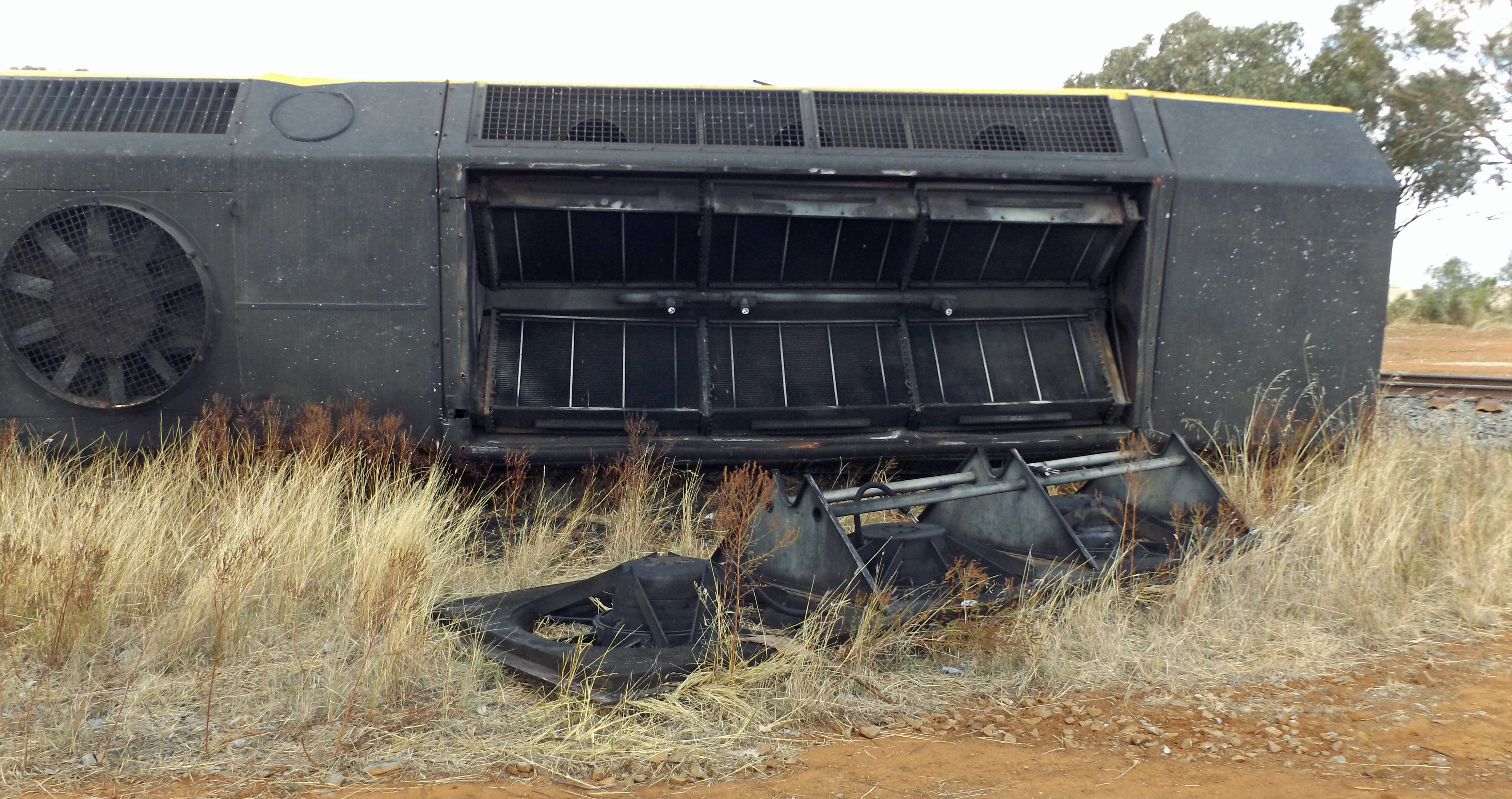
| CLF4 is on its side, but from this angle, doesn't look in too bad a shape considering |
 |
| Oil absorbant pads to catch any oil drips from comtaminating the soil |
 |
| 4910 is also on its side, although hard to tell how much damage it sustained |
 |
| Detail of the hatch raising mechanism on the grain wagon - something normlly hidden by metalwork |
 |
| Unloading hatch details - an angle not normally seen by railfans |
 |
| Interior of a grain wagon, showing the bulkheads |
 |
| The level crossing where the collision occured. It doesn't have any bells of lights relying on a "stop" sign. An error if you ask me - the crossing has been the site of many incidents in the last few years since the line was upgraded, with heavier rail, new ballast and increased train speeds. The other 26 or so grain wagons of the train had been removed, and hauled back to Junee, where I suspect they are back in service |
 |
| Controls in the Cab of CLF1 - taken through the windowless window |
I was very surprised that the wreck scene had no security. The number of people drivng alng the Canola Way that stopped when I was there had no idea of what happened. It could have been a temporary tourist attraction.
What is to become of the locos, and about 14 grain wagons? It is possible that the locos will be trucked through to the Junee roundhouse for assessment, and maybe rebuilding? Junee roundhouse is well suited for this. Grain wagons might end up being cut up for scrap on site. These are my guesses - I suspect a lot depends on insurance. However, the rail line remains closed, and this is a situation that cannot be left indefinitely
Until next time, keep your trains on the track.


.jpg)

.jpg)
.jpg)
.jpg)
.jpg)