Showing posts with label Gatekeeper cottages. Show all posts

Monday, 5 June 2023

Solving the HO housing crisis? Scratchbuilding the Docker Street Gatekeeper cottage

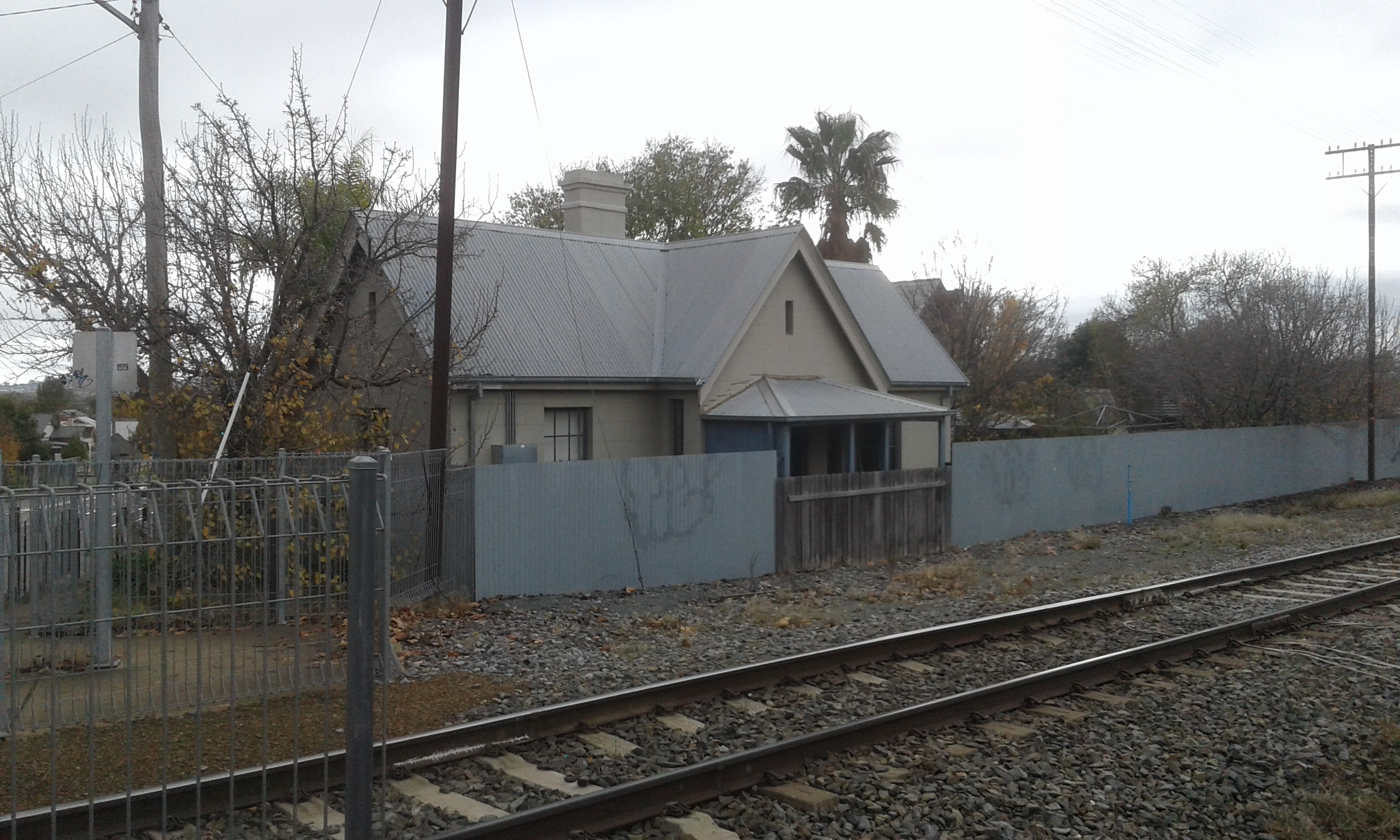
 HO model of the Docker Street gatekeeper cottage


Making models out of styrene is an aspect of the hobby I am finding quite satisfying.  Not having a kit, or even plans just adds to the challenge.  And selection of prototype specific structures, firmly sets the location for the model.


My picture of the cottage taken in 1997, just after the headshunt track (for the gasworks siding) had been removed

There are no kits for this design of cottage, but the high peaked roof is indicative of the gothic style used by Whitton for other stations made in the 1880s during the railway's rapid expansion in NSW.  This cottage, and the now demolished cottage at Urana Street had the same basic design, although each got unique additions.

I have more prototype pictures on an earlier blog post

https://buildingwagga.blogspot.com/2022/07/docker-street-gatekeeper-cottage.html

Plans


Plans were made from photos, and certain aspects of other buildings I did have plans for. Note, I corrected an error in the roof above from the plans I posted earlier.

Making the cottage out of styrene

The first stage is the tedious step, and takes a good number of hours - cutting out.  I use .040 thou Evergreen brand styrene, which is a compromise with strength, and ease of cutting.

All main walls. Note the fibro annex off the rear (northern wall) is not shown, nor is there any window or door on the northern wall.


The slots in the walls are made by chain drilling, and then cutting out with a sharp hobbyknife.  Working from left to right - mark the area with soft pencil; drill a series of holes; cleanup with a knife


Basic assembly, on a base of 0.040 styrene, with cutouts to enable access to the interior after the roof goes on


The roof is the most complex part of the build. Carefully take measurements from the plan, and cuts need to be made on my dwinding supply of evergreen corrugated styrene.  Even so, I did get a few gaps, as can be seen in the above picture.  I filled these with plastic putty.  Re-inforcement of the valleys between the 4 gables was more trial and error

Whilst nowhere as complex as Wagga Station, I still have more things to learn.  The valleys between the roof gables should include a channel, and my roof method doesn't make provisions for it.  Perhaps filling the valleys with leaves may hide things later?


Front veranda awning, and slot for the chimney

Fibro Annex added - it is loose, as I have made some provision for dropping this lower than the main structure which is something that the prototype did


Facias, roof capping, chimney, veranda posts, trim, guttering, and downpipes finish the basic building - now awaiting paint.  I covered my chimney construction, roof capping, and downpipe methods in earlier blog posts.


The lower wall of the fibro annex can be seen in this picture.  It can be positioned lower


I used the same heritage colour that was on the blockwork of Wagga station, rather than the harsh white of my prototype picture.  Why? It seemed right to tie the two models together, and I already had the paint (a Taubmanns "Bamboo Cane" Sample Pot from Bunnings).  This paint was starting to go off, and I had to strain out some lumps, before thinning for the spraying.  

At this point (about 3 weeks ago), my steady progress stopped, and I didn't get back to the workbench to work on the model for 2 weeks.  

A very rough masking of the walls for the Tamiya flat green, and spray paint.  Some parts of the roof didn't quite get the coverage, and were touched up with a brush.  Similar brushwork on the veranda awning.  Tamiya white on the facias, and Tamiya Aluminium for the guttering

Windows were drawn and painted on clear styrene with a bow pen for the mullions, and brush for the edges.  When dry, these would be cut for each window opening

Weathering with pastel rust powder changed the colour of the roof to be closer to the olive of the protoype roof in my 1997 colour picture.  But, I probably overdid it a bit.


After fitting the windows, and doors, the model is now essentially complete.  There is always more that could be done (such as switch boards, and outside toilet block), and I will wait final placement on the layout. I could also fit an interior, as the cottage is to be placed on the asile side of the tracks

 This cottage will not win any awards, as the painted windows lack the 3D effect.  This was a compromise for speed, over fidelity.

Conclusion

Setting a specific location for a layout is a two edge sword.  Selection of scenery, buildings, and other prototype features is a simple matter of just observation, has been done for you.  However, the downside can be a challenge; locating photos of now disappeared structures and then making plans if none exist increases the sense of satisfaction upon completion.

(I am sorry for the delay in posting - but I didn't want to finish this post with yet another unfinished building)

Until next time


Monday, 11 July 2022

Docker Street - Gatekeeper Cottage

 Gatekeeper Cottage for Docker Street - 1


It has been a number of years since I wrote an blogpost on the gatekeeper cottages around Wagga. 

https://buildingwagga.blogspot.com/2019/03/gatekeeper-cottages.html


My picture of the cottage is from 1997, the former headshunt for the sidings beyond Docker Street has been removed - the original alignment was between the rail, and the paling fence

In the subsequent time since that original blog, I have been accumulating additional pictures.  The Docker Street cottage was one I don't have plans for, and as the cottage is privately owned, these pictures will be used to create a simple diagram for a future model build.

An earlier b&w picture showing the headshunt

A set of pictures taken from the Lost Wagga Wagga facebook site. These pictures have a wealth of detail, from the lineside poles, gates, and trains. It however, does give a minor contradiction - that is the date the boom gates were installed.  My earlier 1959 newspaper article on the Edward Street crossing said that boom gates were in place on Docker street - but the 1960s cars and manual gates show a different story 

Another image from the Lost Wagga Wagga facebook site - this shows the installation of timber flangeways on the headshunt - dated 1965. I suspect that this was work involved with widenening the roadway, as part of the work for the boom gates.  Absolute classic showing the attire of the workers, and the foreman

Another angle of the cottage from 1997

2002 is the date - southbound train on the crossing.  The cottage is not visible, on the left hand side of this image. My picture

A further pair of images pinched off the  Lost Wagga Wagga facebook site.  The gatekeeper cottage from this angle looks unchanged in the intervening 80-90 years


A set of pictures taken last month, with my poor phone camera, in poor lighting conditions.

A 1971 aerial view of the cottage.


A more recent aerial shot - this one from sixmaps

Making the plan.

The aerial shots both are dimensioned, but I was able to get a more accurate measurement by counting the corrugations on the roof.  Each corrugation is 3" apart - and thus I was able to determine the full width of the cottage roof is 40 feet.  A little more guesswork for the wall heights, and roof pitch.  I took these from a plan I did have of the old  Best Street cottage, which has some similar features.  What I don't have is any pictures of the door and window placement from the north eastern side of the cottage, so I have made a guess.  I suspect too that the structure is rendered double brick construction, apart from the rear "lean-to".  


Anyway, that's as far as I have got for now.  Cutting out the styrene will be the next stage.

Stay warm


Tuesday, 5 March 2019

Gatekeeper cottages


Gatekeeper Cottages around Wagga


On the previous blog post, I showed a picture of the Intercapital Daylight train crossing the Sturt Highway (Edward Street) on a bridge, and I mentioned in the comments that the bridge replaced a nasty level crossing.  Well the crossing was replaced in 1979, and as I am planning a 1970 timeframe, I have to include the crossing.


Southern Aurora crossing the Edward Street railway crossing in the early 1960s.  The gatekeepers cottage is visible on the LHS of this picture.  Photo provided by Tony McIlwain

1971 Aerial view of the Edward Street gatekeepers cottage
                             

This level crossing was not the only level crossing that I am modelling.  But as this post is on gatekeepers cottages, I will limit this discussion to those with gatekeeper cottages


Docker Street level crossing.  It is 2 tracks, although the rear track is purely a headshunt.  The gatekeepers cottage is no longer needed for the Automatic boom gates.  Picture taken in the 1980s.
Docker Street gatekeepers cottage - 1971 aerial view
Another angle of the Docker Street cottage

 Docker Street.  The manual gates were replaced by automatic lights, bells, and booms prior to 1959.  The cottage still exists, although it was “modernised” almost 20 years ago

-          Bomen.  Unfortunately, this cottage was demolished in 1962

-          Edward Street.  The manual gates were replaced by automatic lights, and bells in October 1959, but the gatekeepers cottage remained until sometime after 1971 before being demolished

Best Street gatekeepers cottage - around 2004. Cottage unoccupied, but in quite good condition. Picture taken from the Best Street bridge

By 2018, the trees had grown, and the cottage is in a sorry state of disrepair.  Vandals had lit a fire inside, partially gutting it, and the most likely outcome is that the cottage will be demolished
The rear of the cottage is not inviting any visitors

-        

  Best Street.  This crossing was replaced by the Best street bridge in 1925.  The gatekeepers cottage still exists – although it is currently heavily vandalised


3829 heads towards Albury in the early 1960s.  The Urana Street gatekeepers cottage is on the right of the picture. Note  the gate on the LHS, and the post-and rail fencing. Thanks to Tony McIwain for the photo


-         
1971 Aerial view of Urana Street cottage.  The gates had been replaced by Bells, and lights
-       

   Urana Street.  This level crossing was modernised with lights, and bells prior to 1970, and remained until Wagga City Council reworked Urana Street with a new overbridge in the 1970s, and the cottage was demolished.

Finding pictures of the missing cottages has been a challenge.  Last year,  I won on ebay a number of cattle wagon kits from Tony McIwain.  After I mentioned that I am looking at modelling Wagga’s stockyards, Tony informed me that he had been a student at Wagga’s Teacher’s college in the early 1960s, and had a few pictures that I might find interesting.  These images have proven of great interest, and I am indebted to Tony for the images, and the insights on NSW Railways in general

Modelling
A year ago, I purchased a gatekeepers cottage kit from the Stuart Walker’s range of laser cut buildings.  I was hoping that this kit would be a close facsimile to the gatekeeper cottages at Wagga.  Well, as to prove Sod’s law, none of the cottages are close to the kit.  Tony’s pictures of the Edward Street cottage seems to show a weatherboard building.  Whilst Tony's image of the Urana Street is also indistinct, access to the 1971 aerial view (courtesy of Wagga Council Intramaps) shows the  cottage at Urana Street, and Docker street look essentially the same.    As I do have some images of  Docker Street, Urana street will be built to the same design.    Wagga Council Intramaps also show the shape and size of the Edward Street cottage.   I don’t have plans for any of these, so I will be checking out a lot of books for photos of similar cottages.  Best Street’s cottage offers the best (pun intended) opportunity for an accurate model.  Peter, from the Wagga Railway Historical group provided me with plans for the Best Street cottage, and I have more pictures than I have shown here

No discussion of the gatekeepers cottages would be complete without reference to the gates.  Well, last week, a couple of pictures were given to me by Max B, showing the Edward Street crossing with manual boom gates.  These gates were controlled by a signal box.  Whilst I do not have any interior views, the gatekeeper would receive bell codes from trains departing Wagga, and Bomen.  The gatekeeper would then work the gates, and clear the signals protecting the crossing.  


Two views of the Edward Street crossing, taken in the 1950s, possibly 1959, but I am guessing by the design of the cars.  The signal box was removed in 1959, although the relay hut visible on the LHS of the picture, lasted until the crossing was abolished in the 1979.


The manual crossing was abolished 27/10/1959, and replaced with automatic lights, and bells.  In the Wagga Wagga Daily Advertiser on the 31/10/1959, had an article describing the experience of a Train driver, John Weisback, who was driving his engine to and from Bomen on the 29th.  His comments were that the new bells and lights were dangerous.  At 9:15am, he narrowly missed a car by 3 foot, and at 4:15pm, taking the engine back, a young boy on a pushbike rode straight through, and only missed the engine by a few seconds.  He asked the question why were no booms installed – as they were at Illabo, Bethungra, and Docker Streets.  (These words were prophetic – not only were booms never installed in the subsequent 20 years of operation, the crossing was the site of many fatalities)
Now the article gives me a hint that there was a loco stabled at Wagga overnight.  I don’t know if it was heading to Junee for a light service, or was it heading to Bomen, to undertake the shunting at the Bomen abattoirs?  If it was the latter, when did this stop?  I know that the Meatworks siding was shunted by mainline trains in the 1980s.  If there was a local shunter in around 1970 time period, that would add much to an operation session.

Research is often frustrating, but ultimately rewarding.