Wednesday, 12 October 2022

A trio of Railway weekends


A trio of Railway weekends


At times, one needs a break from the workbench, with a chance to recharge the batteries, and learn something new. 
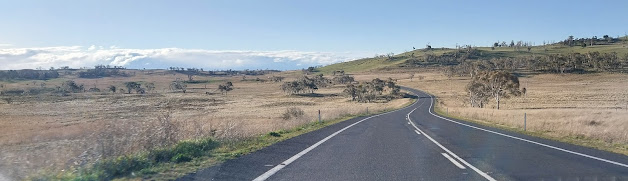
 

The Snowy Mtns Highway south of Cooma shows a landscape that looks dry, unlike the rest of NSW.  This was the view from the car coming back from Bemboka.  The clouds in the distance were an approaching cold front, which was expected to drop some snow.  From a railway viewpoint, the former railway line to Bombala is just to the west (LHS) of this picture.  

Visit to Bemboka

Rob Anderson’s new abode in Bemboka was the site of the NMRA Div 2 meeting in September.  It is a significant distance for me to travel, but Rob’s former layout in the ACT was one that I admired, and operated, so I was curious to see what he was up to. 

After car pooling via Canberra (the most direct route from Junee is via the Snowy Mountians Highway, a highway subject to snow, and the forecast was for snow), we arrived around 11am, with plenty of time for talking with members, prior to the excellent BBQ lunch.  After lunch, we were invited to inspect Rob’s new layout.


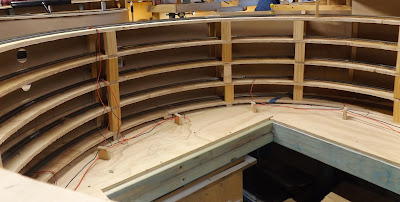
Robs new train room is around 9x6 metres – similar in size to the area I have.  Rob’s layout is  also double deck.  He had maintained his earlier layout theme – being a fictional east-coast mainline, from Melbourne VIC, to Eden NSW.  Rob had incorporated some design changes from his original layout – both staging yards were larger, and connected, and no longer had a duck-under to enter the room. 
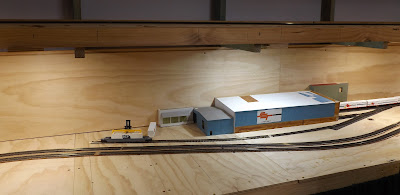

Rob is reusing some of his original layout structures to save time

Both Melbourne, and Eden staging yards share this baseboard - which runs the entire length of the 9 metre wall.  The partition in the middle seperates both staging yards, although there is now a connection that allows continuous running.  The size of these staging yards is a massive improvement from Rob's original layout

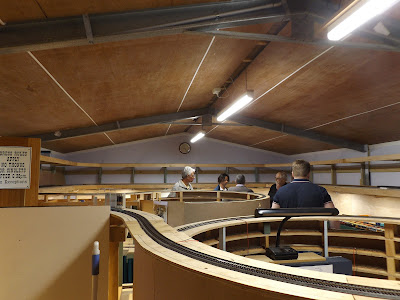
Two helixes are used to raise and lower the main line onto, and off the upper deck.  These are symetrically placed in the room near the main entrance


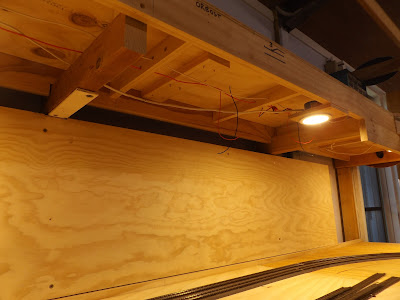
Rob is experimenting with lighting.  I understand that additional lights will be installed to better illuminate the scenes

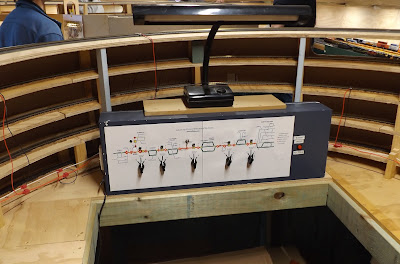
Train operations are controlled by this signal panel.  This is similar to Rob's original layout

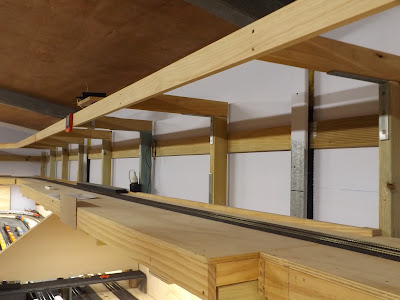
Looking upwards to the roof construction.  Both helixes can be seen

The lighting pelmet for the upper deck is solid.


Petes Hobby Railway.

As part of the The Junee Roundhouse 75th Anniversary Celebrations, Pete Neve had arranged to have a running day on October 2nd.  As one of Pete’s volunteers, I was tasked to operate the gate, and provide commentary for members of the public who came to view the trains.  Pete has 2 operational locomotives, and track which extends from an engineshed, into his frontyard.  The track is hoped to be extended later to finish a continuous loop.  It was good day, and the weather co-operated.
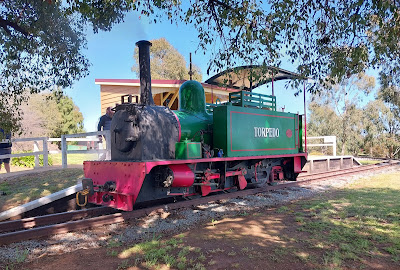
1915 built Hunslet Locomotive "Torpedo". Pete saved this locomotive from a children's playground in Queensland, after it was retired from the canefields.  Fully restored by Ainsworth Engineering in Goulburn


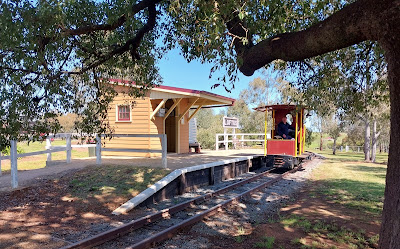
Pete's other operational locomotive is a Ruston engine, built in 1955. Here it is passing Pete's station "Loftus".  The station is a reduced size scale model of an NSW A1 station building, constructed by Phil, and Josh Burke, another pair of Pete's volunteers.  Loftus is a dual name.  It was originally the name of the suburb Pete lived in Sydney, and the original NSW construction name for Junee


Goulburn N scale convention.

Last weekend, the Australian N scale had their first convention after Covid, and held at Goulburn, which is a small city about 2 hours from Sydney, and one hour from Canberra.    Goulburn, like Junee, is a railway town, and boasts a large roundhouse, (now a museum) which was open for Conventioneers on Friday afternoon. The weather wasn’t good, being in constant light rain.   On display were many of the locomotives assembled for the previous weekend’s “Streamliner” event.  (many of the people visiting Pete’s Hobby Railway had been to the Streamliners on the preceeding Saturday).  I hadn’t been to the Goulburn Roundhouse for decades, prior to it becoming a museum, so I was curious to what was lurking inside the sheds.


Some serious workshop machinery on display - all this clutter can give ideas for convincing engineshed modelling


Inside valve gear of a NSW B class mogul, as seen from one of the roundhouse pits


The convention itself was great.  Lots of good layouts on display, including Ross Balderson’s Newcastle 1899, which is a museum standard moving diorama.  The modelling contest had many entries, and the judging this year was done by popular vote.  As I was one of the judges in 2019 for the N scale convention held in Canberra, I do not think this particularly good, as the modellers entering the contest do not get constructive feedback.  The upside was that it is a lot simplier, and the judges get to go to all the clinics.
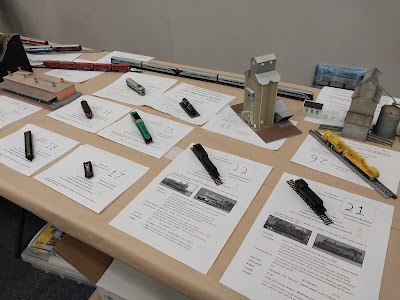


Around 40 entries in the competition.  The locomotive category was won by Stephen Curry with his Kitson tank locomotive (#21 on the sheet above)


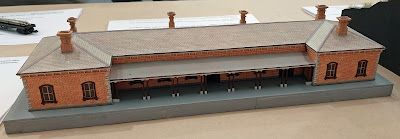
The Castlemaine (Victoria) station won the popular vote for the structures section


This small Inglenook layout was the focus (pun intended) for the "Using your phone camera for layout photography" clinic.

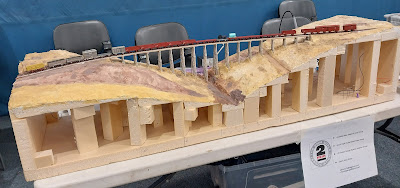
An interesting construction technique, just using foam.

The N scale Japanese themed layout was just one of 9 layouts on display at the convention


The clinics were wide and varied – and most were not scale specific.  To me the one on use of phone cameras for model photography was useful, but the one from Ross Balderson on Streetscapes, including the talk about the Horse Manure panic of 1894, and a method to model horse dung most amusing.
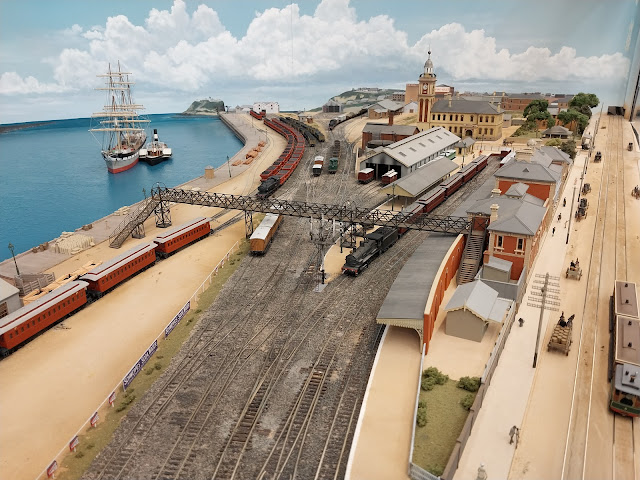

I have shown Ross Balderson's "Newcastle 1899" before on this blog, but the updates keep making it better.


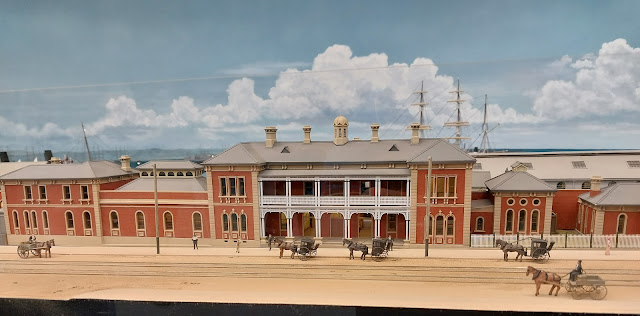
Newcastle Station, showing hansom cabs, and if you look closely, horse dung.  Ross described making the dung, and road in his 'streetscapes' clinic - the dirt was pumice dust as used by dentists.   It is really hard to tell this is N scale, as the level of detail, particularly the etching, is so fine.  

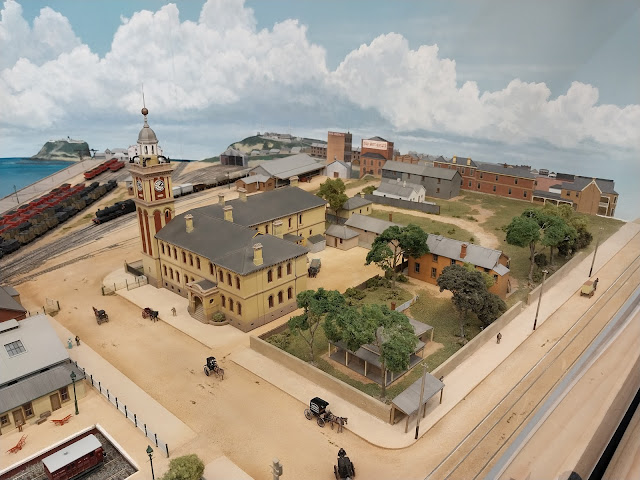
Newcastle Customs House.  Many of the photographs that Ross used to model his buildings had been taken from the Customs House clock tower around 1900.  Another valuable source for Ross's modelling were period photos by Ralph Snowball.


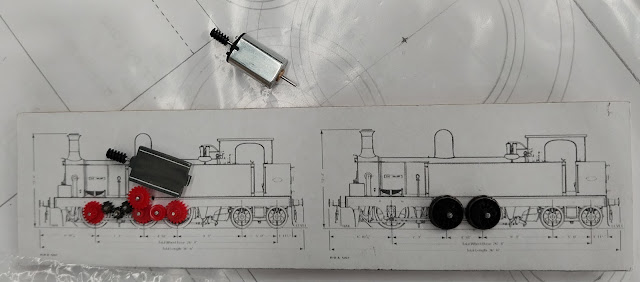
Many of the early locomotive models on show, and operating on Newcastle 1899 were made by Stephen Curry.  Here was a small display by Stephen showing the gears and motor that will be used on a locomotive he will scratchbuild


Being N scale, I didn’t think I would be tempted to buy anything.  But some DCC chips, and 3D printed in colour HO people will be used for a future blog post.  And I was also successful in selling my N scale Bachmann excursion coaches that I bought for testing the N scale Bethungra layout I built for the Junee Broadway Museum


And a bonus for me was that the cheap motel I stayed at, had an ensuite that very closely matches the dimensions of the ensuite I am proposing for my train room area.  Having pictures will assist me in describing to the builder what I am needing.
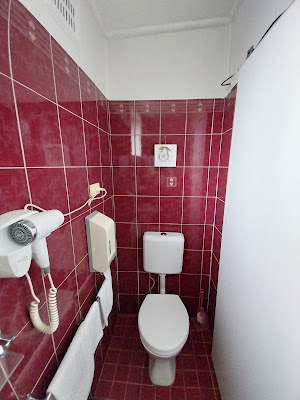


Apart from the tile colour, my motel room ensuite was about identical with the one I am proposing for my train room. The advantages for me is not only having photos to show to a builder, but having used it for 2 nights, it is workable.  Never let an opportunity pass by.


 That's it for now.  Until next time.

Wednesday, 14 September 2022

Edmondson Street Bridge

 Edmondson Street Road bridge - photo diary

One of the bridges that has to be replaced prior to double stacking by Inland rail project, is the Edmondson Street bridge.

In 1995, a Fearnes Wagga bus crosses the bridge.  This is the view looking west, towards Albury

The bridge is on the western end of Wagga's station.  Earlier this week, whilst waiting for my car to be serviced, I thought I would take a few more photos, of this soon to be replaced bridge.


Western side of the bridge, as viewed from the Cassidy Footbridge, in 2016.  Close look at the central pier shows an interesting feature

Another picture from 2016. The security fence prevents access to the line.

The fence also makes picture taking awkward.  This picture from last monday shows part of the fence, as the camera is raised well above ones head. The central pier shows that it might have been extended

Cribbed retaining wall has built up the roadway

Some of the graffitti from 2016, is still present in 2022.  Note the different coloured brickwork where the wing retaining wall changes from a slope, to vertical.  More evidence that the roadway has been widened in the past

Cribbed retailing wall stretches down the hill towards Edward Street (Sturt Highway).  The slope of the roadway is planned to be increased for the new replacement bridge - causing some community concerns.

A 1949 picture of a water tank, and alkali plant, located just west of the bridge.  I do not know when this was removed.  But there is evidence if you look closely. 

A pair of water pipes can just been seen poking above the grass.  The shadow of the bridge railing can be seen on the track.  The fence at the back is the boundary to Mount Erin school.

The roadway, as viewed from the Edward Street intersection.  

The pedestrian railing is quite simple

Lineside poles have the wires going over the road, rather than through the bridge

Access to the bridge is much harder in 2022, than even 2016


View from  "Mothers Bridge" footbridge - looking west.  Note the offcenter pier

From what I can determine, the bridge was built to replace an earlier level crossing approx 1940.  It was originally just a 2 lane bridge, and later widened to 4 lanes with the growth of Wagga Wagga,  south of the railway line - and I dimly remember this happening in the 1960s.  The construction is typical NSW, with sloping wing walls.  The deck is re-inforced concrete, over some shallow steel beams. 

I plan to include a model of this bridge on my layout, but won't have the space for a full roadway ramp.

In 2012, A preserved Southern Aurora passes under the roadbridge on the main line, rather than the platform loop.  Picture from the internet

Inland Rail
As mentioned before, the bridge is planned to be replaced.  Below is the artist impression of the new bridge, as seen on Inland Rail's website

The gradient for the footpath from Edward Street is too steep to meet modern regulations, so there is a zig-zag provided on the station side.  


Some bonus pictures (if you have got this far)


A Junee bound Pacific National wheat train approaches Marrar, on the Junee-Narrandera line on August 18th.  The canola fields are bright yellow.  The road is the Canola Way, and well worth the detour if you are travelling to Adelaide via the Hume/Sturt Hwy

Another classic streamliner at Junee - GM27 last August.  Same spot as 4204 last month.  This one has been also saved from the scrappers, but has been refurbished/rebuilt for SSR (Southern Shorthaul Railroad) freight train operators


Sunday, 14 August 2022

Wagga Wagga Station - a little detailing

 Wagga Wagga station - detailing starts


I have a confession to make.  The Wagga station has suffered some neglect over the last 3 months, whilst I have concentrated on other things - some alas not related to trains.

4204 sitting in Junee yard at the beginning of August.  I first photographed 4204 in Canberra in the early 1980s, during its last NSW government revenue run.  It is great that the loco was not scrapped, and fully restored for excursion work.  This is one of my first pictures with my new Samsung A23 phone - and the quality is far superior to my earlier 7 year old Samsung phone.

This blog post shows some of the little details associated with the station


Toilet block building showing the fence, and storage area.  This picture was taken during the last refurbishment of the station - the brick walls under the render are also visible


The toilet block building cage was made using brass strip, wire, and a LOT of patience

There are a few fences required.  I had some plastic fences in my stash, but frankly, they would have been rather heavy, and distracting.  The cause of one of the delays in progressing the Wagga station, was locating some fine brass fences.  The brass fence acquired via Ebay after a lot of lookibg is much better, whilst still not right, is far better than the plastic ones.


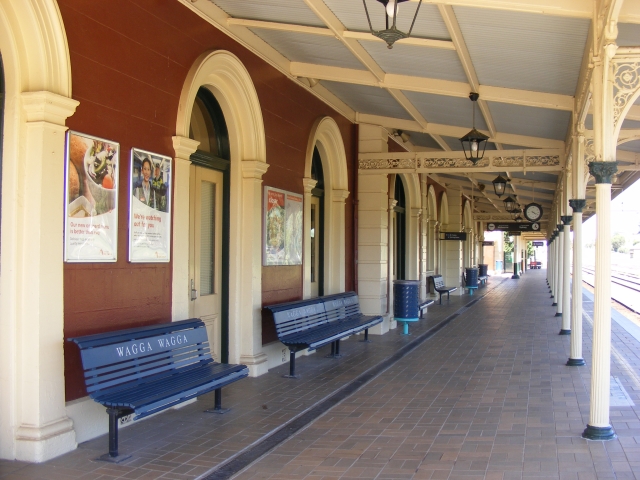
Seats on the platform side


The Wagga station has at least 10 Station seats.  I could only find 7 in my stash.  I believe these are Peco OO - and come moulded in a ghastly green plastic.  I have painted them blue, with black supports.  Not correct, but will do until better examples are obtained 

Luggage carts awaiting use

The etch for the Wagga station awnings, included some extra bits that Ross Balderson had added to fill up the empty spaces.  Two of those spaces were luggage carts.  These are not quite the same as the carts I had photographed, but I won't be too critical

The near disaster

I don't quite believe this happened.  I was replacing the ceiling access panel in my workroom, after it had dislodged after an extremely strong wind entered my workroom, and blew the panel (just a piece of chalk board) into the ceiling space.  In the process of putting it back, the panel dropped through the hole, and in an effort to arrest its fall to the floor, I invertantly directed it to impact the table the station was on.

"Whoops"....(the explicitive has been removed)

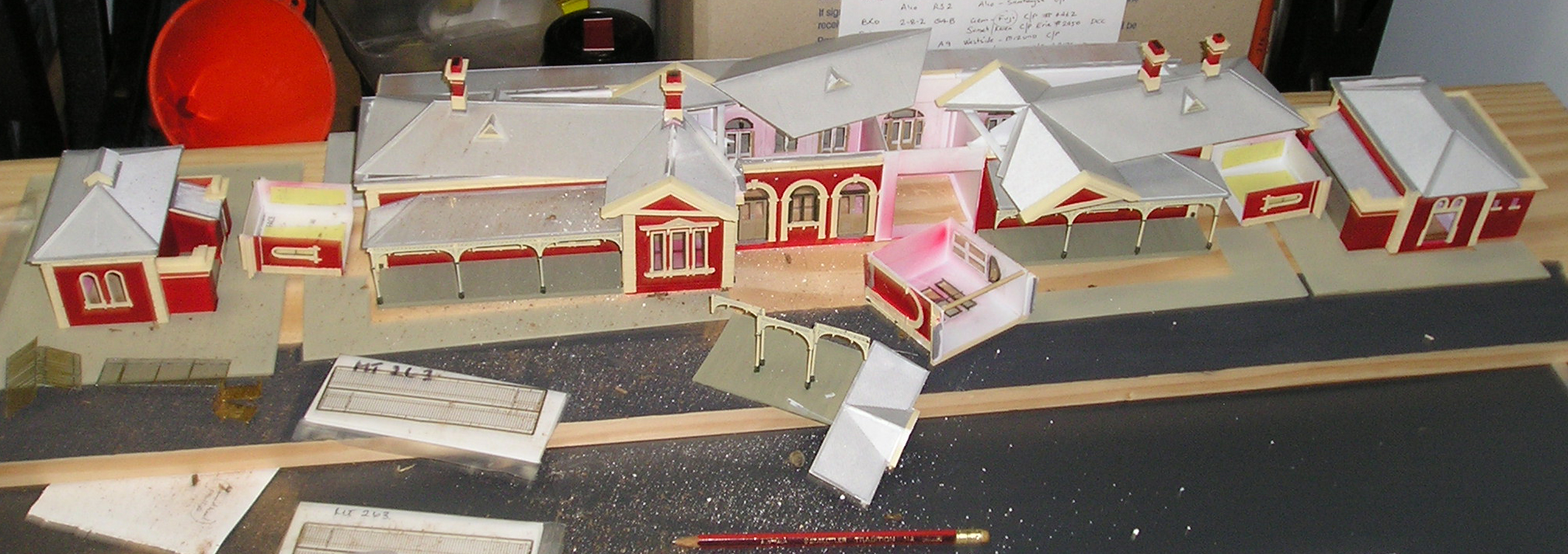
The impact of the ceiling access panel was onto the table, and the panel came to rest over the station - only being stopped from forming a pancake of the station by the shelving behind the station.  The station reacted to the force by returning to a set of subassemblies, with some roof sections bouncing into the chalk of the ceiling panel, causing the damage seen.  The front entrance etch was also slightly bent

Assessment, repairs, and cleaning was not immediate.  I walked away for an hour before returning to assess.  I was pleasantly surprised how little damage actually occured.  The only part that really suffered was the roof ridge of the LHS gable - seen in the above shot as white - partially the chalk, partially as the styrene ridge plastic has been removed, exposing the unpainted corrugated styrene.

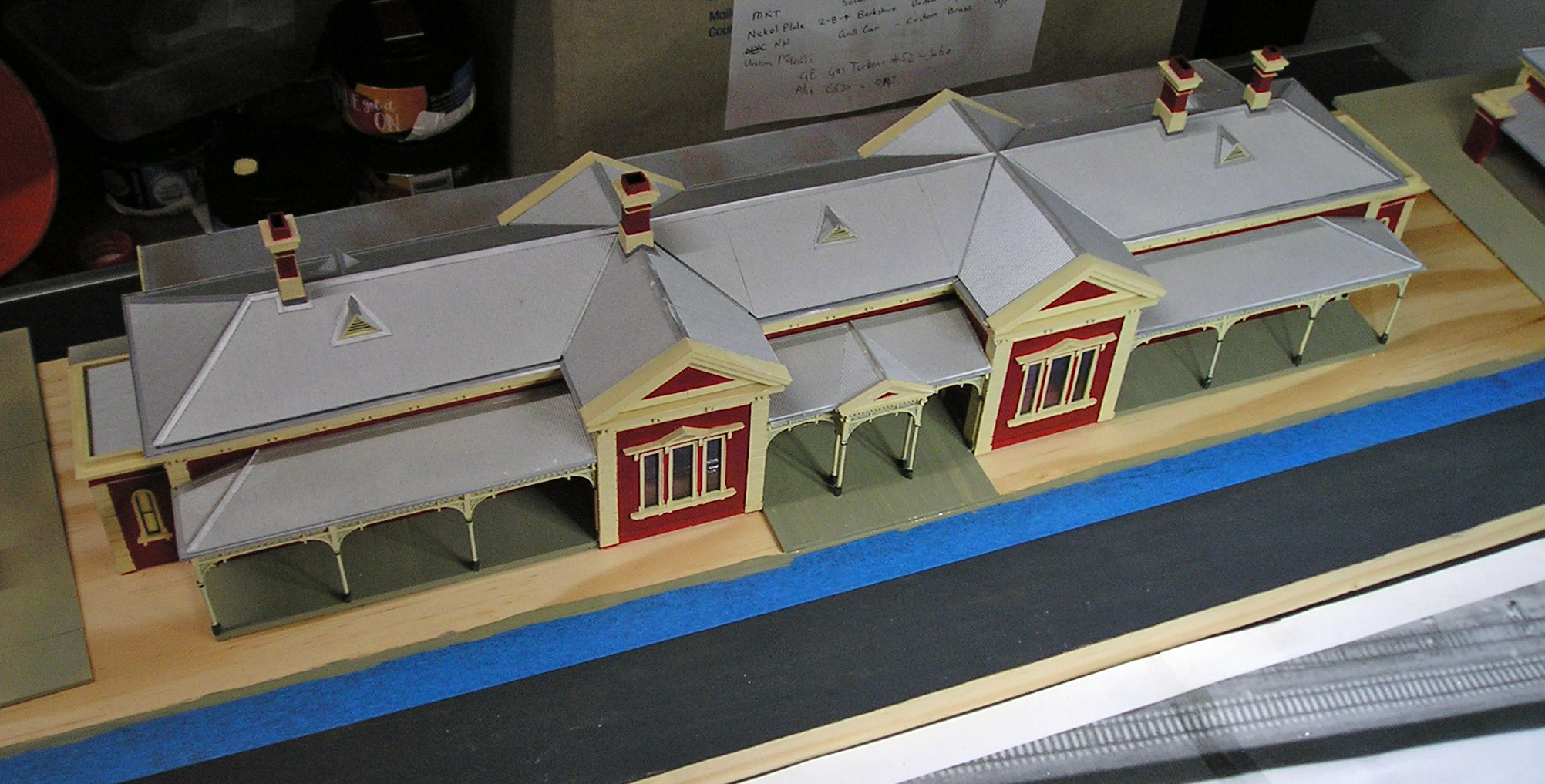
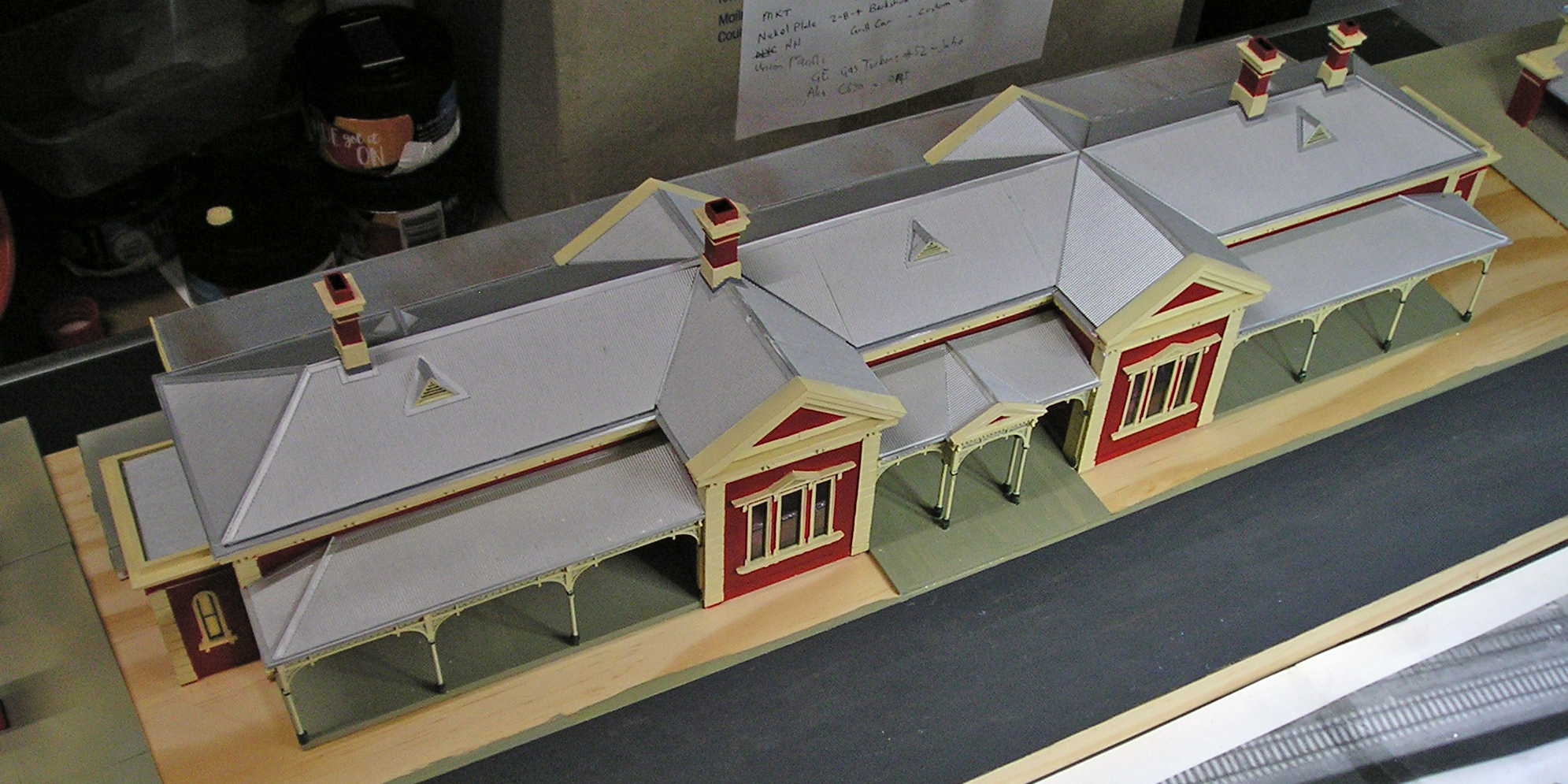
Anyway, after this, I realise that I have to finish the station sooner, rather than later, and then build a protective cradle, so the station can be stored away from flying ceiling access panels etc.

Diorama resumes.


The first steps after the station was "restored" (I still have to respray the roof area) was to secure the concrete paths made previously.  The roadway curb requires a concrete gutter.  I masked a strip on the roadsurface, hand painted the concrete, and removed the masking.  Then the concrete paths were glued with whiteglue.   

Other modelling

On30 - Outback Model Company - NBH coaches.  I had these kits for about 5 years, and sometimes one needs a distraction.  They are laser cut cardboard - fairly simple, lacks details, but could be enhanced with metal handrails, rollup blinds, and passengers with legs hanging out of the windows

A casula hobbies brass/composite kit - grey primed.  It will be good to get this finished - been at least 30 years.... 

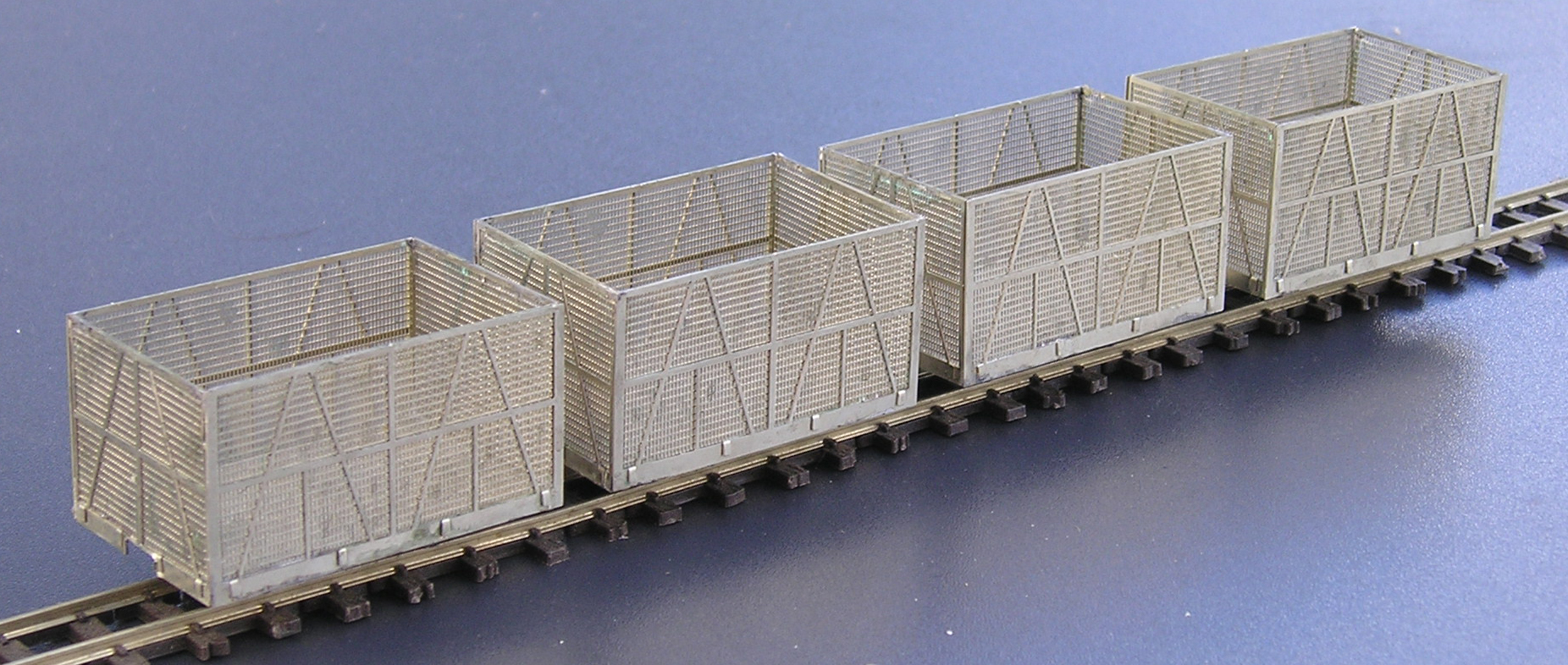
Lyndon Trains - 6 ton cane bins in HOn30.  Gavin from NGDU had asked me to build these for a future "Items of Interest" in that magazine. The etches were produced by Badger Bits - I believe using the same etcher that etched the veranda etches for my Wagga station.  VERY NICE

OCY etc container wagons.  I bought these foolishly at a recent Trains Planes and automobile auction. They were cheap. Unfortunately, they arrived extensively damaged, as the packers had put them all into a large plastic bag, not individually wrapped.  I have cosmetically restored them,  repainted over the previous horrible paint, and added some weight.  Containers and kadees will be needed too.  May make a block train on the future layout - but don't look too closely. 


Last Saturday, I travelled over to Murrumbateman for the Div 2 NMRA meeting at Stephe Jitt's MMR new house.  Stephe had found a house with a big train room to accomodate his Kangaroo Valley railway, albeit with some modifications.  I took the opportunity to take some better phone camera pictures of some of the sections, relocated from his previous obode in Yass.  Stephe tells me that he hopes the layout will be fully operational again in 3 years.  Knowing Stephe, he is conservative with his estimates


Well, that's it for now.  Lessons I hope have been learnt.